A Keepsake Box for a Shared Family Recipe
A keepsake box for a shared family recipe keeps the original card legible and adds just enough context to help relatives understand and use it.
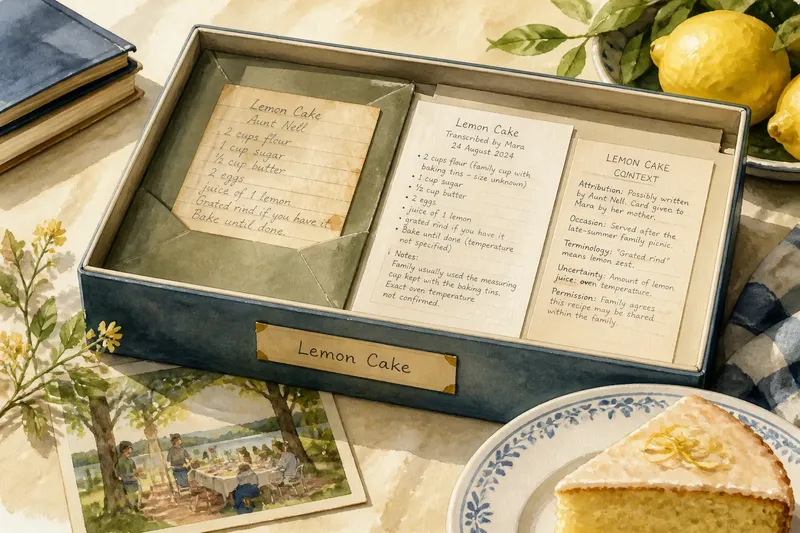
What belongs in a keepsake box for a shared family recipe, and what should stay out? Imagine Mara has inherited a handwritten card for her aunt’s lemon cake. She wants cousins to be able to make it, but she does not want to turn one useful recipe into a miniature family archive. The box she assembles is modest: the original card, a readable copy, and a few details that explain the cake’s place in the family.
This invented situation offers a useful way to think about recipe keepsakes. The aim is not to make an old card look pristine or to collect every related memory. It is to preserve the object, make the instructions usable, and record the context that would otherwise disappear.
Choose the occasion
Mara begins with the family gathering where the cake is usually served: a late-summer reunion. That occasion gives the box a clear purpose. It also helps her decide which details belong. A note about serving the cake after the picnic meal is relevant; a broad family tree is not.
Occasion-specific boxes work best when they answer a small question. Is this recipe being passed to a new household, shared at a reunion, or given to someone who has started baking? The answer can shape the contents without requiring a grand theme or decorative treatment.
For Mara, the intended users are cousins who know the cake but have never made it. The box therefore needs to preserve the original handwriting while making the method understandable to a first-time baker.
Keep the source intact
The original card is the keepsake, not a surface to improve. Mara does not erase smudges, trace over fading ink, laminate it, or add notes in the margins. Those interventions could obscure the very evidence that makes the card personal, and some materials may react poorly to adhesive or plastic.
She places the card in a clean, archival-quality paper folder, then sets the folder in a rigid box that closes without pressing on it. The card lies flat, away from loose crumbs, rubber bands, and anything damp. A simple paper enclosure is less dramatic than a decorative sleeve with a magnetic flap; it is also less likely to make the recipe harder to retrieve.
If the card is brittle, stained, or otherwise fragile, a paper conservator can advise on suitable housing. A home box should not be treated as a repair bench.
Make a working copy
Mara creates a separate transcription for cooking. She copies the ingredient list and method as written, then marks uncertain wording with a note rather than silently correcting it. The handwritten card remains untouched, while the copy can be handled beside a mixing bowl.
Her copy preserves practical ambiguities instead of pretending they are resolved. The card says “a cup of flour” without naming a cup size, and “bake until done” without specifying an oven setting. Mara adds a clearly identified note: the family usually used the measuring cup kept with the baking tins, and she has not confirmed an exact temperature. Those details help the next baker ask informed questions instead of mistaking an assumption for an original instruction.
She dates the transcription and identifies herself as its transcriber. If another relative later supplies a correction, that person can add a dated note to the copy. The original does not need to carry the burden of every new interpretation.
Add useful context
Mara limits the context to three pieces: who wrote the card, when the family usually served the cake, and one practical note about an ingredient name that has changed. She asks relatives before attaching a name or personal story to the record. A keepsake can be shared without turning every private memory into exhibit material.
A small context sheet can include:
- Attribution: the writer’s name, if known, and how the card came to the current keeper.
- Occasion: the gathering or meal associated with the recipe.
- Terminology: a brief explanation of an unfamiliar ingredient or tool.
- Uncertainty: wording that remains unclear, marked as unresolved.
- Permission: any limits the family has agreed on for sharing the card or its story.
Not every box needs every item. If a detail cannot be verified, Mara says so plainly. “Possibly written by Aunt Nell” is more useful than confident attribution assembled from family guesswork.
Choose the container
The box should suit the paper and the occasion, not compete with them. Mara chooses a small, rigid box with enough room for the folder, transcription, and context sheet. The contents sit flat and can be lifted out without tugging. She avoids a box that is packed so tightly that its lid presses on the card.
She writes the recipe name on a removable paper label, rather than directly on the original or permanently on the box. That modest choice lets the container be reused if the family later changes how it stores the recipe. The box stays in a dry cupboard away from direct sunlight and cooking steam.
What should the box answer?
Should the original recipe card be handled?
It can be viewed when needed, but the transcription is the better working copy. Clean, dry hands and a clear table reduce casual handling, while the folder gives the card support during removal.
What if the recipe has missing instructions?
Keep the uncertainty visible on the transcription and ask relatives who may remember the method. Do not add an unverified temperature, ingredient, or timing to the original card.
How much family history belongs in the box?
Include context that helps someone identify, understand, or use this recipe. Broader stories can remain in another family record, where they have room and consent of their own.
Can the recipe be shared beyond the family?
Ask the people whose handwriting, names, or personal stories appear in the material before circulating copies. A recipe may be easy to copy; its context may not be yours alone to publish.
Pass it on clearly
At the reunion, Mara gives the box to a cousin who wants to bake the cake. The cousin can see which paper is original, which is a transcription, and which notes are later additions. The result is not a complete account of the family or even a definitive version of the cake. It is a small record that can be read, questioned, and used.
A keepsake box for a shared family recipe succeeds when its contents explain themselves without making the original do more than it can. Keep the source distinct from later notes, name what is uncertain, and leave enough room for the next person to add a careful correction.