Woven, Knitted, or Felted: How to Read a Fabric’s Structure
Identify woven, knitted, and felted fabric by its visible structure, then describe it clearly when sorting cloth for sewing, repair, or storage.
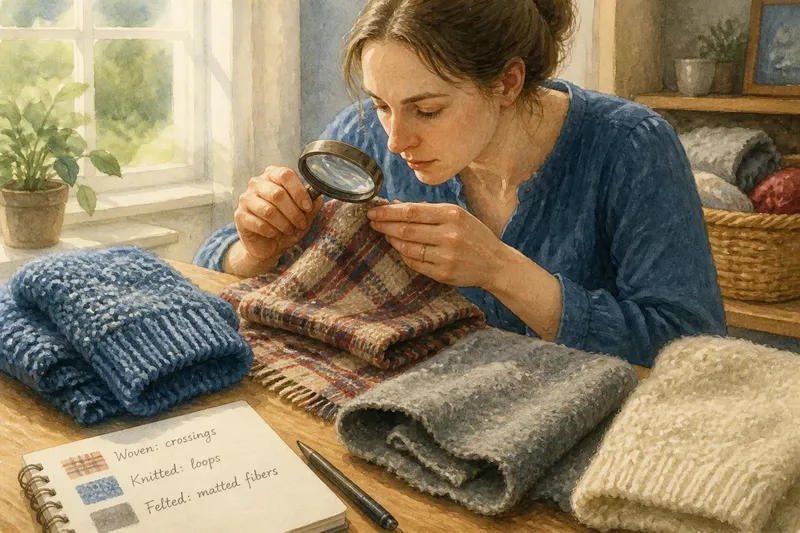
Is that scarf knitted, woven, or felted? To identify woven, knitted, or felted fabric, look for crossing threads, linked loops, or a mat of fibers—not just a pattern or a soft surface. A plaid may be woven, a plain gray cloth may be knitted, and felt can be shaped into something bag-like. A bright window and a few minutes of careful looking are usually enough to begin.
Three Structures
Woven cloth is made from two sets of yarn crossing each other. Knitted cloth is made from interconnected loops. Felt forms when fibers mat together without a regular grid of yarns.
These terms describe construction, not fiber. Wool can be knitted, woven, or felted; cotton can be woven or knitted. A brushed surface or printed pattern may hide the structure underneath.
Read Woven Threads
Look for two thread directions crossing at repeated intersections. The lengthwise yarns are called the warp; the crosswise yarns are the weft. In a plain weave, they often alternate over and under. Denim’s diagonal lines come from a twill weave, while satin weave uses longer floats that can make one side look smooth or glossy.
Inspect an exposed edge or a less decorated patch, but do not pull a thread. A finished hem may conceal the weave, so look at the cloth itself. Following one visible yarn with your eyes can help: it usually runs fairly straight before passing over or under another yarn.
Follow Knitted Loops
Knitted yarn forms linked loops. On stockinette, the face often shows small V shapes and the reverse has bumps. Ribbing forms alternating columns of knit and purl stitches, commonly at cuffs and necklines.
Look for a looped chain at an edge or in an existing snag; do not widen a hole. Knits may stretch more readily across their width than comparable woven cloth, but stretch is only a supporting clue. Elastane, a bias cut, or a loose weave can make other fabrics stretch too.
Say you find a plain wool hat with repeated V-shaped columns and a visible edge. If the Vs resolve into linked loops, describe it as knitted; if the edge is bound and hides the loops, record the visible clue and leave the construction uncertain.
Inspect Felted Cloth
Felt has a dense surface of matted fibers rather than a regular grid of crossing yarns or rows of loops. Traditional wool felt is made by matting wool fibers; needle-felted and industrial nonwoven materials use other processes or fibers. A cut edge may resemble the body instead of separating into distinct yarn ends.
“No visible yarn structure” is a more careful observation than claiming to see every fiber. Brushing, pile, or a thick surface can obscure what lies underneath. Do not wash, rub hard, or pull a corner to identify it; those actions may alter the object.
Check the Edges
An edge can make construction easier to see, but binding, a serged seam, fringe, or a folded hem may hide it. A cut knit may curl and a cut woven fabric may fray, though finishing and fiber content affect those tendencies. Treat edge behavior as supporting evidence, not a verdict.
- Crossing yarns: If two thread directions form repeated over-under intersections, identify the visible structure as woven; if the threads are hidden by a finish, inspect an untrimmed area or record uncertainty.
- Linked loops: If you can trace connected loops or rows of Vs, identify the structure as knitted; if the surface is too fuzzy to follow, check an edge without pulling it.
- Matted fibers: If the cloth has no orderly yarn grid and its surface appears compacted, describe it as felted or felt-like; if the process matters, check the label or maker’s information.
- Bound edge: If binding covers the original edge, do not infer construction from that edge; look at the fabric body or note that the finish prevents inspection.
- Stretch: If the cloth stretches, do not classify it from stretch alone; look for loops, crossings, or a fiber mat before deciding.
- Mixed panels: If different sections show different structures, describe each section separately; if a surface finish obscures them, keep the description provisional.
Keep any care label with the cloth. Structure helps describe how fabric is made, while fiber content and finishing affect how it behaves.
When Is Identification Uncertain?
Can a fabric look felted without being felt?
Yes. Brushed knits, napped wovens, and bonded nonwovens can have a fuzzy or compact surface. Describe what is visible, and consult the label or maker if the production method matters.
Can one object contain more than one structure?
Yes. A coat may combine woven outer cloth, knitted trim, and felt-like panels. Inspect and describe each part rather than assigning one construction to the whole object.
Does stretch prove that cloth is knitted?
No. Elastane, a bias cut, and a loose weave can all add stretch. Use visible loops or crossings as the stronger clues.
What if a seam or finish hides the structure?
Look for an exposed edge or an undecorated area without opening the seam. If nothing reveals the construction, note what you can see and leave the identification unresolved.
Record What You See
Write a short description that separates construction from fiber and appearance: “knitted wool with a ribbed cuff,” “plain-woven cotton with a printed plaid,” or “dense felt-like cloth, fiber unknown.” This is more useful for sorting, sewing, or discussing repair than a description such as “soft sweater fabric.”
Return to the phrase woven, knitted, or felted fabric by asking one practical question: can you see crossings, loops, or a mat of fibers? If a finish blocks the view, record that limitation rather than turning a guess into a label. Keep the original care label with any saved fabric; it can answer questions that surface inspection cannot.