Why Wood Grain Never Repeats
Why wood grain never repeats: learn to read growth rings, pores, rays, and figure so you can choose boards with variation that suits the object.
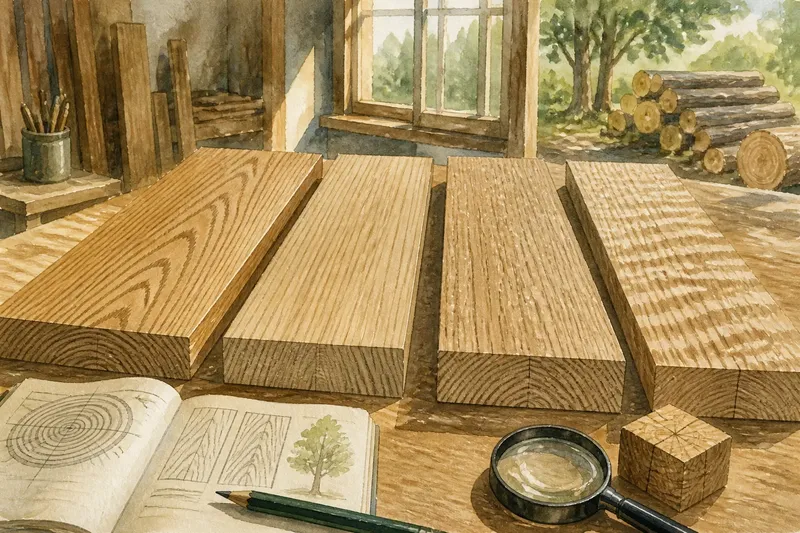
Why does a wood tabletop show bands, curls, and flecks that no printed pattern quite reproduces? Why wood grain never repeats comes down to a tree’s growth: the marks in a board are evidence of how its wood formed, not decoration added afterward. You can learn to read those marks before choosing a board, and see why one cut looks calm while another seems to move.
Start with growth
A tree adds wood around its trunk over time. In many species, the contrast between wood formed during different parts of a growing season creates visible growth rings. Cut across the trunk, those rings appear as roughly circular bands. Cut along it, they become lines, arcs, or tapered shapes, depending on the board’s position and angle.
Rings are not annual calendar marks in every species or every climate. Their visibility varies, too: some woods show strong contrast, while others have subtle bands that are hard to distinguish without close inspection. A board’s grain therefore reflects both the tree’s growth and the way a saw passed through it.
Before comparing boards, look at the end grain—the cut face at either end. The ring pattern there gives clues about the board’s orientation within the trunk. Then look along the broad face. The same growth structure will appear differently there, as a line running with the board or a sequence of arches.
Read the end first; the long face is the next part of the story.
Read the cut
Board names such as flatsawn, quartersawn, and riftsawn describe how a piece was cut in relation to the trunk’s growth rings. They are useful descriptions, not promises of a particular look. Sawing practice, tree shape, and the board’s exact position all affect the result.
- Flatsawn: The growth rings meet the broad face at a relatively shallow angle. The face often shows sweeping arches or cathedral-like forms, especially where the cut passes near the center of the trunk.
- Quartersawn: The rings meet the broad face more nearly at a right angle. The grain tends to look straighter, and some species show prominent ray markings across the face.
- Riftsawn: The rings meet the face at an intermediate angle. The result often has a more consistently straight appearance, though the exact angle and visible figure vary.
These terms describe orientation, not quality. A board with curved grain is not automatically inferior to one with straight lines. The useful question is whether the pattern, grain direction, and board shape suit the object you are making. For a broad, quiet surface, a straight-grained board may be appealing; for a small panel, a lively curve may give the piece its character.
Say you are choosing oak for a cabinet door and want the face to look relatively restrained. Imagine laying several boards side by side under the same light, then turning each to inspect its end grain. You might select the pieces whose broad faces show more even lines and fewer large arches, while reserving a more strongly figured board for a smaller panel where its pattern can be seen without dominating the whole cabinet.
Notice wood anatomy
Growth rings are only one source of variation. Wood is made from cells arranged in different ways, and those structures affect its visible texture. In hardwoods, pores may be large and easy to see, as in oak, or much less conspicuous. In softwoods such as pine, the cells do not present the same large, open pores, though contrast between growth zones can still make the grain distinct.
Rays are narrow structures that extend outward from the center of a trunk. On a board cut in a way that exposes them, they may appear as flecks, ribbons, or shimmering marks. Oak is known for conspicuous ray figure in some cuts. The marks are part of the tree’s anatomy, not a surface motif applied by a finisher.
Knots mark places where branches grew from the trunk. Their presence changes the grain around them, which often bends and swirls as it passes the branch base. A knot can be a visual feature, but its condition and position also matter to how a board can be worked. For a project where strength or clean machining matters, ask the lumber supplier or a qualified craftsperson to assess the specific board rather than judging the knot by appearance alone.
Color variation can have several causes, including differences in the wood’s formation and the species’ natural coloring. A pale stripe beside a darker one may follow a growth boundary; a stain or finish can also change the way those colors appear. Look at unfinished wood when possible, and remember that a coating may deepen or alter contrast.
Follow the figure
“Figure” is the visible pattern created by grain, anatomy, and the way a board has been cut. It can include stripes, curls, waves, flecks, or irregular patches. Some figure comes from ordinary differences in growth; some is associated with unusual grain direction or local changes in the tree. The term describes appearance, not a separate layer added to the wood.
Curly figure, for instance, can make a board’s surface seem to change as the viewing angle changes. A finish may make that shifting effect easier to see by reflecting light, but it does not create the underlying structure. Likewise, a dark line or curl in a board is not automatically evidence of a defect. Inspect its context: does the grain remain continuous, is there a crack, and does the board lie flat?
When selecting a piece, move it under steady light and view it from more than one angle. A phone photograph can help you compare boards, but its color may differ from the wood in person. If the finished object will contain several adjoining boards, place them together before committing to a layout. This lets you judge the transition between patterns, rather than choosing each piece in isolation.
Let the intended viewing distance guide how much figure you want. A small, busy pattern may read as texture from across a room; close up, it may reveal distinct marks worth preserving.
Why does wood grain never repeat?
Are growth rings the same as grain?
Growth rings are bands formed as a tree adds wood, while grain is a broader term for the direction and visible arrangement of its structure. On a board, the cut can turn ring boundaries into straight lines or arches, so the face does not simply display a ring diagram.
Does straight grain mean stronger wood?
Straight grain can make a board easier to work predictably for some tasks, but strength depends on more than appearance, including species, defects, and how the piece will be used. A visible pattern alone is not a reliable structural assessment.
Can a finish create wood figure?
A finish can change color, contrast, and reflected light, making existing figure more or less apparent. It cannot produce the growth structure beneath the surface, though stains and other treatments can add a separate color pattern.
Why do matching boards look different?
Two boards from the same species can come from different parts of different trees, with different growth histories and cuts. Even adjacent boards from one trunk can show distinct faces because the saw meets the rings at changing angles.
Choose with the object
Start with the object’s shape and viewing conditions, not a general idea that one grain pattern is best. A long tabletop makes lines and changes in color especially visible. A small shelf or drawer front gives a strong knot or curl less room to overwhelm its surroundings.
For a multi-board surface, decide whether you want the boards to contrast or sit quietly together. To compare them, place their faces upward in the order you might use them, then check how the grain direction and color move across the group. Matching every line is rarely possible; a pleasing sequence can instead keep neighboring boards from making abrupt visual jumps.
If you are buying finished furniture, ask what kind of wood is used and whether the visible pattern is natural grain, veneer, or a printed surface. Veneer is a thin layer of real wood, so it has genuine grain, but its appearance depends on how that layer was cut and arranged. A printed pattern imitates wood’s appearance without using a wood surface. A seller should be able to clarify which applies.
For a specific board, species names, grading terms, and suitability can depend on the supplier and intended use. Check the product information or ask a knowledgeable woodworker when the distinction affects your decision.
Keep the record visible
Grain is easiest to appreciate when the surface is not asked to imitate something else. Before choosing a stain or finish, decide whether you want to emphasize the existing contrast or keep the face subdued. Different finishes can shift color and sheen, so use a sample on the same species if you need to judge the effect. A sample is a comparison aid, not a promise that every board will respond identically.
When laying out parts for a project, mark the board’s orientation before cutting. A pencil mark on the hidden face can help you keep track of which edge or face you meant to show. That small note is especially useful when pieces have similar colors but different grain directions; boards become less cooperative once they have been cut into identical rectangles.
For everyday decisions, the search phrase why wood grain never repeats leads to a useful answer: each face records a particular tree, a particular place within it, and a particular path through the saw. Choose the face that suits the object, then leave enough of its natural variation visible for the material to remain recognizable.