From Patch to Story: The Visible Mending Tradition
Visible mending turns a damaged garment into a record of care and choice, with patches and stitches that let repair become part of its appearance.
What does a visible mend say that a hidden one does not? Visible mending makes the answer part of the garment: a patch or line of stitching is allowed to show, so a repaired place can record practical attention and personal choice. The visible mending tradition is not one technique or a single historical custom. It is a broad way of treating repair as both useful work and a deliberate element of an object’s appearance.
What counts as visible mending?
A visible mend is a repair that remains legible after the work is done. The patch may differ in color, weave, or shape from the surrounding cloth; the stitching may form a clear grid or an exposed line. The important distinction is not whether the repair looks decorative. It is whether the maker has chosen not to disguise it as untouched fabric.
That choice can be subtle. A patch cut from a matching shirt may blend in at a glance, while its edge remains visible on closer inspection. A contrasting piece of cloth can make the repair unmistakable. Neither approach is inherently more honest or more skillful. One lets the repair sit quietly; the other gives it a more prominent place in the garment’s design.
Visible mending also differs from decoration added to intact cloth. A stitched motif can be ornamental without repairing anything. In visible mending, the work responds to a specific weakness or opening, and its appearance grows from that practical task. The repair has a reason to be there before it has a style.
Where did the tradition come from?
People have long repaired cloth because fabric represents labor, material, and use. A tear, worn elbow, or thinning knee does not necessarily make a garment useless. Sewing a patch over a weak area can restore coverage, distribute strain, and keep a piece in circulation. In settings where replacement cloth was scarce or costly, making repairs visible was often less a manifesto than an ordinary consequence of careful use.
Different communities developed different ways to mend, shaped by the fabrics, tools, and habits available to them. Darning can rebuild a worn area with crossing threads. A patch can cover a hole or reinforce cloth that has become thin. Decorative stitching may hold fabric in place while adding a pattern. These methods should not be collapsed into one universal tradition: similar practical needs can lead to distinct local techniques and meanings.
Some contemporary interest in visible mending draws on Japanese practices often discussed through terms such as sashiko and boro. Sashiko refers to forms of patterned stitching associated with reinforcement and cloth work; boro is commonly used for layered, repaired textiles that accumulated patches through repeated use. These terms have specific cultural contexts. They are not interchangeable names for any attractive patch, and a contemporary maker can acknowledge that distinction rather than treating an entire tradition as a decorative effect.
The broader history is not a simple change from necessity to fashion. Practical mending and aesthetic choice have overlapped for a long time, even when a wearer did not describe a repair as art. Today, a deliberate contrast can make that overlap easier to see: the garment remains useful, while the repaired area becomes part of its visual character.
Why leave a repair visible?
A visible repair can make an object’s use easier to read. The darn at a sock’s heel, a patch on a work shirt, or a line of reinforcing stitches at a bag’s seam marks a place where the material met wear and received attention. The mark is not a complete biography; it cannot reveal who wore the garment or what happened to it. It can, however, show that a damaged area was addressed rather than ignored.
Visibility can also express a wearer’s preference. Someone may like the contrast of a bright patch, want to keep a favorite garment in rotation, or prefer repair to pretending that fabric never wears out. Another person may choose a close match because a conspicuous mend does not suit the garment or the way they dress. The choice is personal, not a test of commitment.
There is a useful distinction between a repair that is visible and one that is made conspicuous for its own sake. A patch still has to perform its job. If the fabric around a hole is thin, stitching only the hole’s edge may leave the surrounding cloth ready to split. A sound repair responds to the wider area of strain, even if the finished shape is irregular.
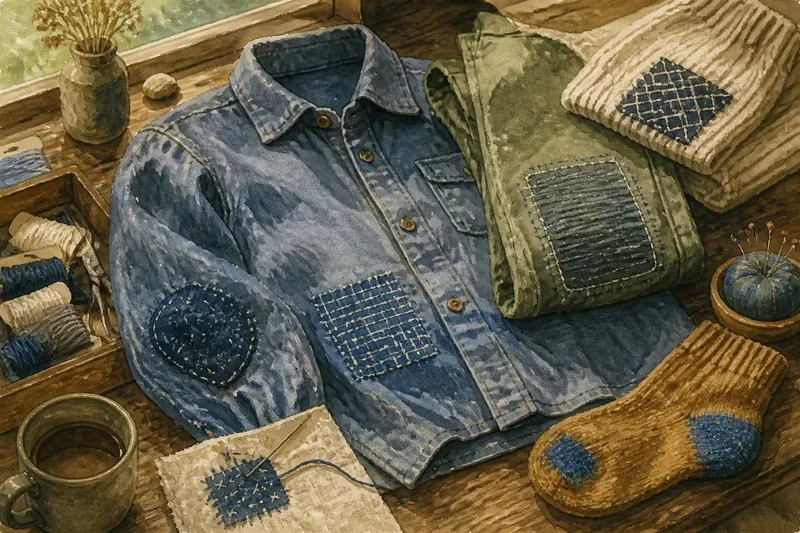
Say you find a small tear near the pocket of a cotton overshirt, with the surrounding cloth still firm. You could place a contrasting patch behind the tear and stitch through both layers in a simple grid. The expected visible result is a stable area with a clear pattern that differs from the shirt; if the fabric is also thinning around the tear, a larger patch may be needed to support more than the opening itself.
Which repair suits the damage?
Start by looking at what the cloth is doing, not at a favorite stitch pattern. A clean slit in otherwise sound fabric asks for a different response from a soft, worn-through patch. The repair should support the material around the damage and allow the garment to move as intended.
- A small opening in sturdy cloth: A patch behind the hole can cover the opening and anchor the repair in firmer fabric. A contrasting cotton scrap makes the work easy to see.
- Thinning cloth: Reinforcement over a broader area may be more useful than stitches concentrated at the weakest point. Visible darning can bridge worn threads, though it takes time to build a stable surface.
- A split seam: The seam may need to be rejoined before any decorative reinforcement is added. A conspicuous outer stitch can highlight the repair, but should not substitute for securing the cloth’s edges.
- Stretch fabric: A rigid patch can pull against a garment that needs to flex. Choose materials and stitching that allow suitable movement, or use a repair designed for stretch textiles.
- A high-friction area: A patch may protect the fabric, but bulky edges can rub or catch. Consider where the garment touches a chair, bag strap, shoe, or skin before deciding how prominent the repair should be.
These are starting points rather than universal rules. The fiber, weave, placement, and use all matter. A patch that behaves well on a woven cotton shirt may not suit a fine knit or a slippery lining. For work involving unusual, delicate, or valuable textiles, a textile conservator or experienced repair specialist can offer more appropriate advice.
How can a patch look intentional?
Intentional does not have to mean perfectly geometric. A patch can look considered because its color relates to a button or printed detail, because its shape follows the damaged area, or because the stitches form a steady rhythm. A deliberately uneven patch can work too, provided the edges are secured and the shape does not leave weak points unsupported.
Material choice sets much of the tone. A patch from another part of the same garment makes the repair visually restrained, though cutting from a usable area can simply create a new problem. A contrasting cotton scrap gives a clear change in color and texture. For a knit, a compatible piece of knit cloth may move more naturally than a firm woven scrap. Keep scraps from retired garments in a small envelope, with a note about their fiber or source if known.
Thread can either disappear into the cloth or announce the work. A matching thread creates a quieter edge; a contrasting thread makes the stitch line easier to see. Ordinary running stitches can be arranged in rows or a grid, while darning uses repeated threads to rebuild a worn area. The design need not imitate a named cultural technique to have character. If you borrow a specific tradition, learn what the term means and avoid presenting a loose visual resemblance as the full practice.
Before sewing, place the patch where it can cover the damaged area and extend into stronger cloth. Check its position while the garment is on a flat surface and, where practical, while wearing it. A patch at a knee or elbow must tolerate bending; a pocket repair should not obstruct the pocket. Small adjustments in placement can matter more than an elaborate stitch.
Does visible mending hold up?
It can, if the repair matches the fabric and the forces acting on it. No stitch style makes a weak patch indestructible. A repair can fail when it catches only fragile threads, uses cloth that stretches differently, or places a hard edge where repeated rubbing occurs. The shape and reach of the patch, the condition of the surrounding textile, and the garment’s use all affect how it behaves.
After mending, handle the garment normally and notice whether the repair pulls, puckers, or catches. If it does, that is useful information: the patch may be too stiff, the thread too tight, or the damaged area larger than it first appeared. Reworking a repair is part of repair, not evidence that the first decision was foolish. Cloth is a poor audience for pride.
Care should suit both the garment and its patch. A sturdy cotton shirt may tolerate ordinary laundering, while delicate fabric or unfamiliar thread may need gentler treatment. Follow the garment’s care information and the patch or adhesive manufacturer’s directions where relevant; when the item is valuable or fragile, seek qualified textile care advice.
What do readers ask?
Is visible mending the same as sashiko?
No. Visible mending is a broad description for repairs left apparent, while sashiko names particular Japanese stitching practices with their own histories and contexts. Some visible mending may draw on sashiko, but the terms do not mean the same thing.
Can a visible patch be neat without matching?
Yes. A patch can contrast in color or texture and still look considered if it follows the damage, sits comfortably on the garment, and has a clear edge or stitch pattern. Neatness is not the same as invisibility.
Should I mend a hole before it grows?
If the surrounding cloth is still stable, repairing it early may leave more sound fabric available to support the work. Check the area around the opening rather than judging only the hole itself; a small tear surrounded by thin cloth may need a broader repair.
Can visible mending make a worn garment feel personal?
It can, because the repair adds a choice the garment did not have before: a particular patch, thread, or arrangement of stitches. That does not make every repair sentimental, but it can turn continued use into a visible part of the object’s character.
When does a repair become a story?
A patch cannot tell a whole story on its own. It may show that a garment was kept, altered, and returned to use, but the meaning belongs partly to the person who wears it and partly to what they choose to say about it. That modest limit is useful: a repair need not carry a grand message to be worth seeing.
Visible mending offers a practical choice with an aesthetic consequence. The cloth is repaired, and the mark of that work remains available to notice. If you are deciding how to mend a garment, consider not only which thread will hold but whether you want the repair to blend in, stand apart, or sit somewhere between. The visible mending tradition begins with that small decision, followed by the less glamorous business of making the patch stay put.